
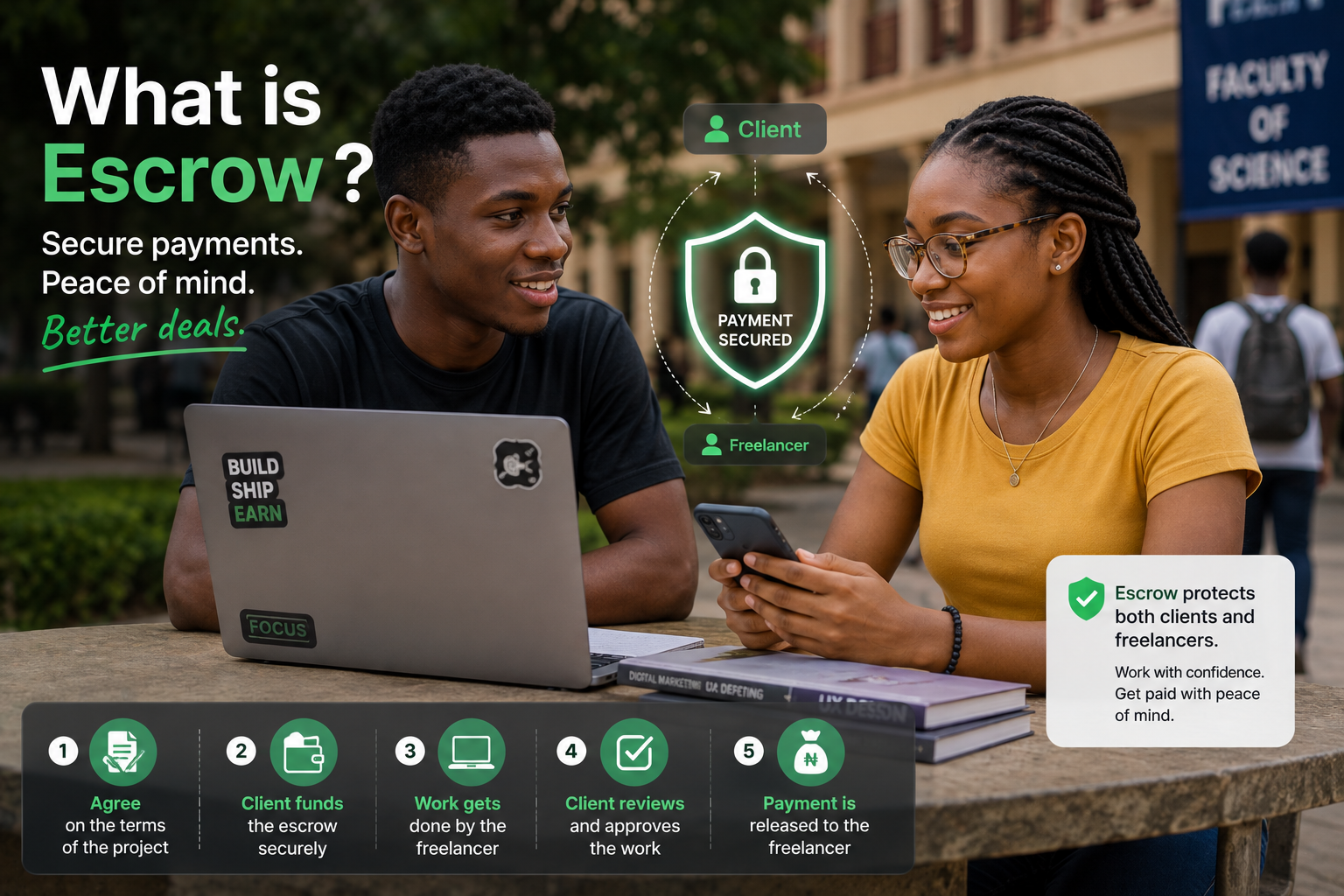
What Is Escrow and Why Do Student Freelancers Need It?
You get a gig to design a flyer, build a website, edit a video or write content.
The client agrees to pay you ₦50,000 when you're done.
You spend several days working on it, submit the final work—and then the client disappears.
No payment. No replies. Just vibes.
If you've ever worried about this happening, you're not alone. Getting paid is one of the biggest concerns when taking freelance gigs, especially when you're still building your reputation and don't know the person you're working with.
This is where escrow comes in.
What Is Escrow?
Escrow is a payment arrangement where a trusted third party temporarily holds money until agreed conditions are met.
Instead of the client sending the money directly to the freelancer, the money is held securely by the escrow service.
A simple example:
- You agree to design a logo for a client for ₦30,000.
- The client deposits the ₦30,000 with an escrow service.
- You complete the agreed work.
- The client confirms that the agreed requirements have been met.
- The escrow service releases the money to you.
The important part is that the money isn't simply sitting in the client's account while you're doing the work.
The exact rules vary depending on the escrow provider or platform, so always check how its payment and dispute process works before accepting a job.
Why Does Escrow Matter for Student Freelancers?
Freelancing can be a great way for students to make money while building practical skills.
You might take gigs in:
- Graphic design
- Programming
- UI/UX design
- Writing
- Video editing
- Photography
- Social media management
- Tutoring
- Data entry
- Digital marketing
But there's a difference between finding a client and getting paid by the client.
Someone can sound trustworthy during negotiations and still fail to pay after you've completed the work.
Escrow helps reduce this particular risk by making payment part of the transaction instead of relying entirely on someone's promise.
How Escrow Protects Freelancers
1. It Reduces the “Work First, Pay Later” Risk
One common freelance arrangement is:
“Just do the work first. I'll pay you when you're done.”
That can work when you already trust the client.
But when you're dealing with someone you've never worked with before, you're taking most of the risk.
You've already invested your time and skills, while the client hasn't necessarily committed their money.
With escrow, the agreed payment is deposited before the work is completed, subject to the service's rules.
That gives you more confidence that the money exists for the job.
2. It Gives Both Sides a Clear Agreement
Escrow isn't just about protecting freelancers.
It can protect clients too.
The client doesn't necessarily have to release the money immediately just because they've deposited it. The funds are released according to the agreed conditions and the escrow service's rules.
This creates a clearer process:
Agree → Fund → Work → Review → Release
Instead of:
Agree → Work → “Bro, I'll send it tomorrow.”
And tomorrow becomes next week. 😭
3. It Can Help With Disputes
What happens if you deliver the work and the client says it isn't what they requested?
Or the client claims you didn't complete the job even though you believe you did?
A legitimate escrow platform may have a dispute process that allows both sides to present evidence before a decision is made.
That doesn't mean escrow guarantees that you'll win every dispute.
It simply gives the transaction a more structured process than arguing through WhatsApp DMs.
Escrow Doesn't Mean “No Scam Is Possible”
This is important.
Escrow is a risk-reduction tool, not a magic anti-scam button.
Scammers can still create fake escrow websites, send fake payment links or impersonate legitimate services.
Before using an escrow service, verify:
- The actual platform you're using
- Its official website or app
- How funds are deposited
- Its fees
- Its withdrawal process
- Its dispute rules
- Whether the transaction is actually covered by escrow
Don't click a random “escrow payment” link sent by a stranger and assume you're protected.
What Student Freelancers Should Agree on Before Starting a Gig
Even when escrow is available, don't skip the basics.
Before you start working, make sure you and the client agree on the important details.
Define the Deliverables
What exactly are you producing?
For example, if you're designing a flyer, clarify whether the agreement covers:
- One design or multiple designs
- Number of revisions
- File format
- Delivery date
- Additional versions or sizes
“Design a flyer” can mean very different things to different people.
Agree on the Price
Don't start a ₦50,000 job based on:
“We'll discuss payment later.”
Agree on the price before you begin.
If there are additional costs or extra work, clarify how they will be handled.
Set a Deadline
Both sides should know when the work is expected.
If the client keeps changing the requirements, the original deadline may no longer be realistic.
That's another reason to keep your communication and agreements documented.
Keep Your Communication
Don't rely entirely on verbal agreements.
Keep relevant messages, invoices, briefs, files and payment records.
If there's a disagreement later, you have something to refer back to.
What If You're the Client?
Escrow can be useful for students hiring other students too.
Maybe you're paying someone to:
- Build a website for your student organisation
- Design a departmental event flyer
- Edit your project presentation video
- Create a logo
- Handle social media content
- Help with another legitimate digital task
You also have something to lose if you pay someone upfront and they disappear.
Escrow can give clients a structured payment process while giving freelancers confidence that the agreed funds have been committed.
The key is to make sure the job requirements are clear before money is deposited.
How Escrow Fits Into Student Gigs
One of the biggest worries when taking a freelance gig is simple:
“What if I finish the work and the client doesn't pay me?”
This is where escrow can make a real difference.
On** DexTask**, escrow is built into the gig experience. When a client funds a gig, the agreed payment is held in escrow rather than being paid directly to the freelancer immediately.
The freelancer can then focus on completing the agreed work without relying solely on a promise that payment will come later.
The basic idea is:
**Client funds the gig → Payment is held in escrow → Freelancer completes the work → Work is reviewed → Payment is released according to the agreed process. ** This creates a clearer transaction for both sides.
For the student freelancer, there's greater confidence that the client's payment has been committed to the gig. For the client, the payment isn't simply handed over before the agreed work is completed.
That is one of the ways** DexTask's Gigs & Errands** experience is designed to make student-to-student transactions more structured and safer than simply agreeing on a gig through a random WhatsApp DM.
Of course, you should still read the terms of each gig carefully, agree on the deliverables and understand how payment and disputes are handled before starting work.
Why This Matters When You're Just Starting Out
As a student freelancer, you may not have years of client experience or a long list of testimonials.
You might be getting your first ₦10,000 gig, your first ₦50,000 project or your first client outside your immediate circle.
That makes trust especially important.
Escrow helps create a payment structure where both the client and freelancer know** what happens to the money during the transaction. ** Instead of:
**“Do the work first; I'll pay you later.” ** You have a more organised process where payment is funded and held before the work moves forward.
For students already using DexTask to find gigs, this means you don't just have a place to discover opportunities—you also have escrow built into the transaction to help make the payment process more secure and predictable.
Red Flags to Watch Out For
Whether you're using escrow or not, be careful when a client or freelancer:
- Pressures you to start immediately without agreeing on the terms
- Sends suspicious payment links
- Asks for unnecessary financial information
- Changes the agreed price after you've started
- Refuses to document the agreement
- Wants you to move the transaction to an unfamiliar platform
- Claims payment has been made without you being able to verify it
- Asks you to pay a strange “release fee” or “withdrawal fee” through an unverified channel
If something doesn't feel right, pause the transaction and verify what's happening before continuing.
Escrow Is About Reducing Risk
As a student freelancer, your time is valuable.
You may be balancing lectures, assignments, tests, projects and hostel life while trying to make extra money through your skills.
The last thing you need is to spend an entire weekend working on a gig only to start chasing someone for payment afterwards.
Escrow can reduce that risk by creating a clearer payment arrangement between the client and freelancer.
But it works best alongside other good practices: clear agreements, realistic deadlines, documented communication and proper verification.
Whether you're coding at midnight, designing flyers between lectures or editing videos from your hostel, don't just focus on getting the gig.
Think about how you're going to get paid safely too.
Escrow helps bridge that gap by giving clients and freelancers a structured way to handle money while the agreed work is being completed. And with DexTask, escrow is part of the gig experience, giving students a more organised way to find gigs and transact with each other.
Ready to put your skills to work? Explore DexTask's Gigs & Errands and find student gigs with escrow built into the transaction.
Written by
Blessing Ajayi · DexTask
Publisher: DexTask
Published on the DexTask blog covering campus mobility, student infrastructure, and product updates across Nigeria and Africa.
Related posts
Resolving Payment Disputes for Campus Work
A campus gig doesn't always go exactly as planned. Learn what to do when a client or freelancer disagrees about payment, deliverables or completed work.
Buying Fairly Used Gadgets on Campus: A Checklist
A fairly used gadget can save you money, but a bad deal can leave you with an expensive problem. Use this simple checklist before buying a phone, laptop or other gadget on campus.
Why Verified Student Communities Are Safer for Trading
Trading with fellow students can be convenient, but how do you know who you're dealing with? Here's why verified student communities can make buying and selling on campus safer.