
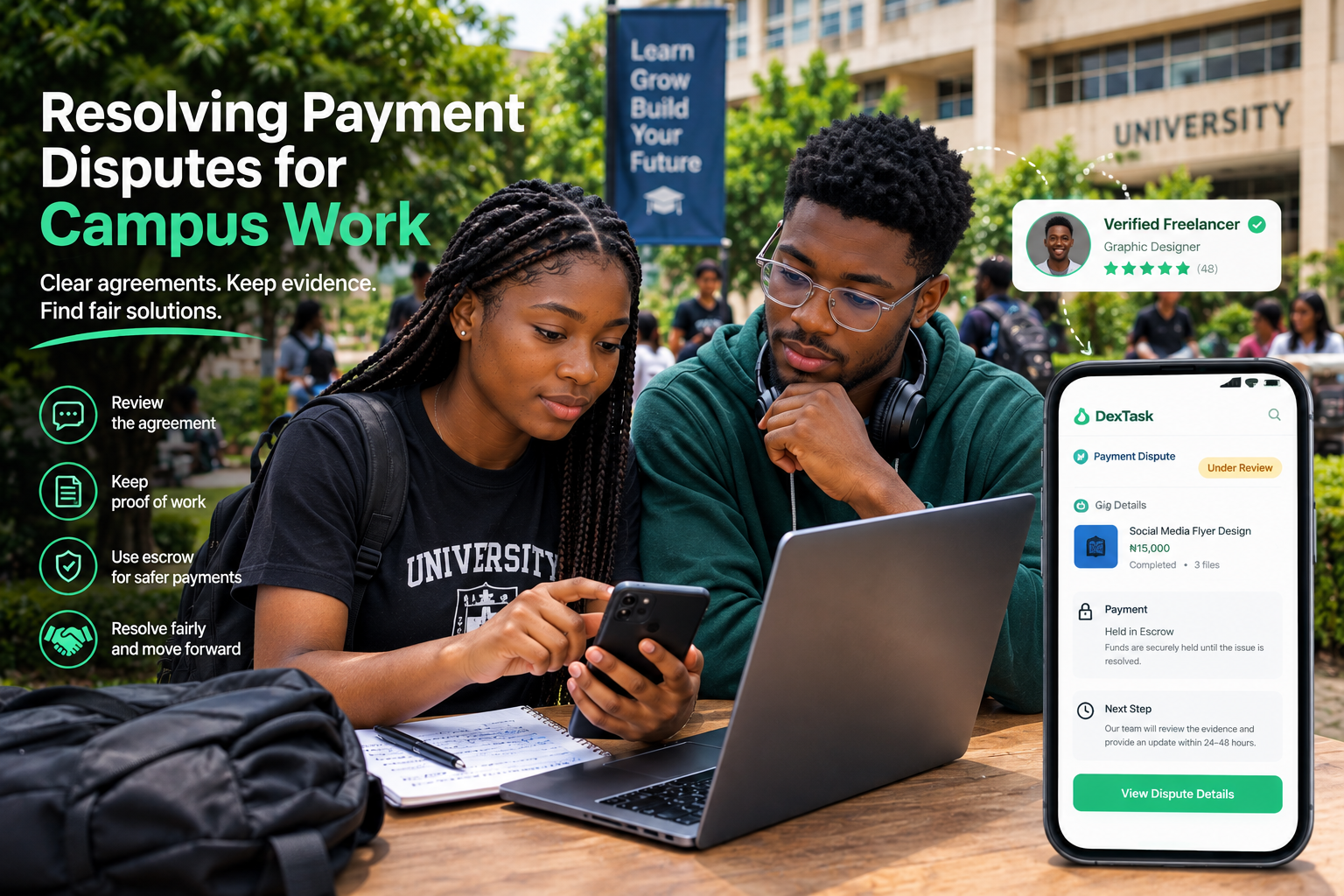
Resolving Payment Disputes for Campus Work
You finish a gig you've spent hours working on.
You send the final work to the client.
Then they say:
“This isn't what I asked for.”
Or maybe you're the client, and the freelancer says they've completed the task—but what you received doesn't match what you agreed on.
Now you're both arguing over payment.
These situations can happen with campus gigs, especially when agreements are made casually through WhatsApp or word of mouth.
The good news is that a disagreement doesn't have to become a full-blown fight.
The first step is understanding what was actually agreed on and using the available evidence to work towards a resolution.
What Is a Payment Dispute?
A payment dispute happens when the people involved in a transaction disagree about money or whether the agreed work was completed properly.
For example:
- A freelancer says the job is complete, but the client disagrees.
- A client refuses to pay the agreed amount.
- A client requests additional work that wasn't part of the original agreement.
- A freelancer delivers late and the client wants to withhold payment.
- The client says the work doesn't match the agreed requirements.
- Both sides have different understandings of what was included in the gig.
Not every disagreement means someone is trying to cheat the other person.
Sometimes, the original agreement simply wasn't clear enough.
Start With the Original Agreement
Before arguing about who is right, go back to what you both agreed to.
Look at:
- The original gig description
- Messages between you and the client
- The agreed price
- The deadline
- The requested deliverables
- Any revisions that were agreed upon
- Payment records
For example, imagine you agreed to design three Instagram flyers for ₦15,000.
After you submit them, the client asks for five more designs and says they should be included in the original price.
That's different from discovering that the original three designs don't match the agreed requirements.
The details matter.
Talk Before Escalating
If the disagreement happened through a misunderstanding, a simple conversation may solve it.
Instead of:
“You are trying to scam me.”
Try:
“Let's go back to what we agreed. The original brief says three designs, but you're requesting eight. Can we clarify what should be included?”
Keeping the conversation focused on the agreement makes it easier to find a solution.
If you're the freelancer, explain what you've completed.
If you're the client, explain specifically what doesn't meet the agreed requirements.
Avoid turning a payment disagreement into a personal argument.
Keep Evidence of the Work
This is one reason freelancers should document their work from the beginning.
Keep relevant:
- Briefs
- Messages
- Drafts
- Final files
- Delivery timestamps
- Payment records
- Feedback from the client
- Changes requested during the project
You don't need to screenshot every single message you send.
Just make sure the important parts of the transaction can be retrieved if there's a disagreement later.
What If the Client Says the Work Isn't Good Enough?
Ask them to be specific.
“It's not good” doesn't give you much to work with.
Instead, ask:
“Which part doesn't meet the agreed requirements?”
Maybe the client requested a blue flyer and received a red one.
That's straightforward.
Maybe they requested a five-page website and received three pages.
That's also clear.
But if the client simply changes their mind after seeing the completed work, you may need to look at whether those new requirements were part of the original agreement.
Clear deliverables make these conversations much easier.
What If the Freelancer Didn't Complete the Work?
The same principle applies from the client's side.
If you paid for a specific service and the freelancer hasn't delivered what was agreed, don't immediately assume the person is trying to keep your money.
First, ask for an update.
There could be a genuine delay or misunderstanding.
If the work is incomplete, refer back to the original requirements and discuss what remains outstanding.
If the issue cannot be resolved directly, use the platform's available dispute process where applicable.
How Escrow Can Help
This is where escrow becomes particularly useful.
With a normal direct payment, the client may send money straight to the freelancer before the work is completed.
If something goes wrong, both sides may have to negotiate what happens next.
With escrow, the agreed payment is held according to the platform's transaction process while the gig is being completed.
DexTask uses escrow for its gig transactions.
This gives the transaction a defined payment structure rather than relying entirely on:
“I'll pay you when you're done.”
If a disagreement occurs, the relevant transaction records and the platform's dispute process can be used according to its terms.
Escrow doesn't mean every dispute automatically goes in favour of the client or freelancer. The outcome depends on the circumstances and the platform's rules and review process.
If You're Using DexTask
If a campus gig is taking place through DexTask, keep the important parts of the transaction within the platform where possible.
That includes:
- The gig details
- Agreed deliverables
- Payment information
- Relevant messages
- Work submitted
- Changes to the original agreement
If a dispute arises, follow DexTask's stated dispute process rather than trying to create a separate payment arrangement outside the platform.
The exact process and requirements can change as the platform develops, so users should check the current terms and instructions provided by DexTask for their transaction.
What Freelancers Should Do
If you're the person completing the work, protect yourself by making the scope clear before starting.
Define the Deliverables
Don't agree to:
“Design something nice.”
Agree to something more specific:
“Three social media flyers in PNG format, with two rounds of revisions.”
The clearer the deliverable, the easier it is to determine whether you've completed the job.
Record Major Changes
If the client adds significant work during the project, confirm the change in writing.
For example:
“Just confirming that the two additional designs will be added to the original three. The new total is ₦25,000.”
A simple message can prevent a much bigger argument later.
What Clients Should Do
Clients have responsibilities too.
Give a Clear Brief
Don't expect a freelancer to read your mind.
Provide the information they need to complete the work properly.
Give Useful Feedback
If something needs changing, explain what needs to change and relate it to the original requirements where possible.
Don't Add Unlimited Work
A freelancer agreeing to one task doesn't automatically mean you've purchased unlimited revisions or additional services.
If you need more work, discuss the additional cost and timeline.
Common Mistakes That Make Disputes Worse
Changing the Agreement Without Confirming It
If the original job changes significantly, document the new agreement.
Deleting the Conversation
Keep relevant messages until the transaction is completely settled.
Paying or Accepting Payment Outside the Agreed Process
If you're using a platform with escrow, moving the payment elsewhere can remove some of the structure designed to protect the transaction.
Getting Personal
Calling someone a scammer or threatening them usually doesn't solve the actual disagreement.
Focus on the work, payment and evidence.
A Simple Dispute-Resolution Checklist
If a campus gig payment dispute happens:
-
Stop and review the original agreement.
-
Check the agreed price and deliverables.
-
Gather relevant messages and payment records.
-
Compare the completed work with the original requirements.
-
Ask the other person to explain their concern.
-
Try to resolve genuine misunderstandings directly.
-
Document any revised agreement.
-
If using a platform, follow its official dispute process.
-
Avoid making additional payments or arrangements outside the agreed process without understanding the consequences.
The Best Way to Prevent a Dispute
The easiest payment dispute to resolve is the one you prevent from happening.
Before starting a campus gig, agree on four basic things:
What → How much → When → What counts as complete
For example:
“I'll edit a 10-minute video for ₦20,000, deliver it by Friday, and include two rounds of revisions.”
That's much clearer than:
“I'll edit your video for 20k.”
The more specific the agreement, the less room there is for different interpretations later.
Final Thoughts
Payment disputes don't always mean someone is dishonest.
Sometimes the client expected something different. Sometimes the freelancer misunderstood the brief. Sometimes the scope of the work changed halfway through.
The best approach is to return to the agreement, look at the evidence and communicate clearly.
For students doing campus gigs, clear expectations and proper payment structures can make these situations much easier to handle.
And when a platform like DexTask uses escrow for its gig transactions, there is an additional structure around the payment while the agreed work is being completed.
So before your next gig starts, don't just ask:
“How much am I getting paid?”
Also ask:
“What exactly am I agreeing to?”
Looking for a more structured way to handle student gigs? Explore DexTask's Gigs & Errands and take on campus work with escrow built into the transaction.
Written by
Blessing Ajayi · DexTask
Publisher: DexTask
Published on the DexTask blog covering campus mobility, student infrastructure, and product updates across Nigeria and Africa.
Related posts
What is Escrow and Why Do Student Freelancers Need It?
Getting a freelance gig is exciting—until you finish the work and start wondering if you'll actually get paid. Learn how escrow works and how it can help student freelancers reduce payment risks.
Buying Fairly Used Gadgets on Campus: A Checklist
A fairly used gadget can save you money, but a bad deal can leave you with an expensive problem. Use this simple checklist before buying a phone, laptop or other gadget on campus.
10 Best Side Hustles for Nigerian Students in 2026
Looking for a side hustle as a Nigerian student? Here are 10 realistic ways to earn around your lectures, plus how DexTask can help you turn your skills into campus opportunities.