
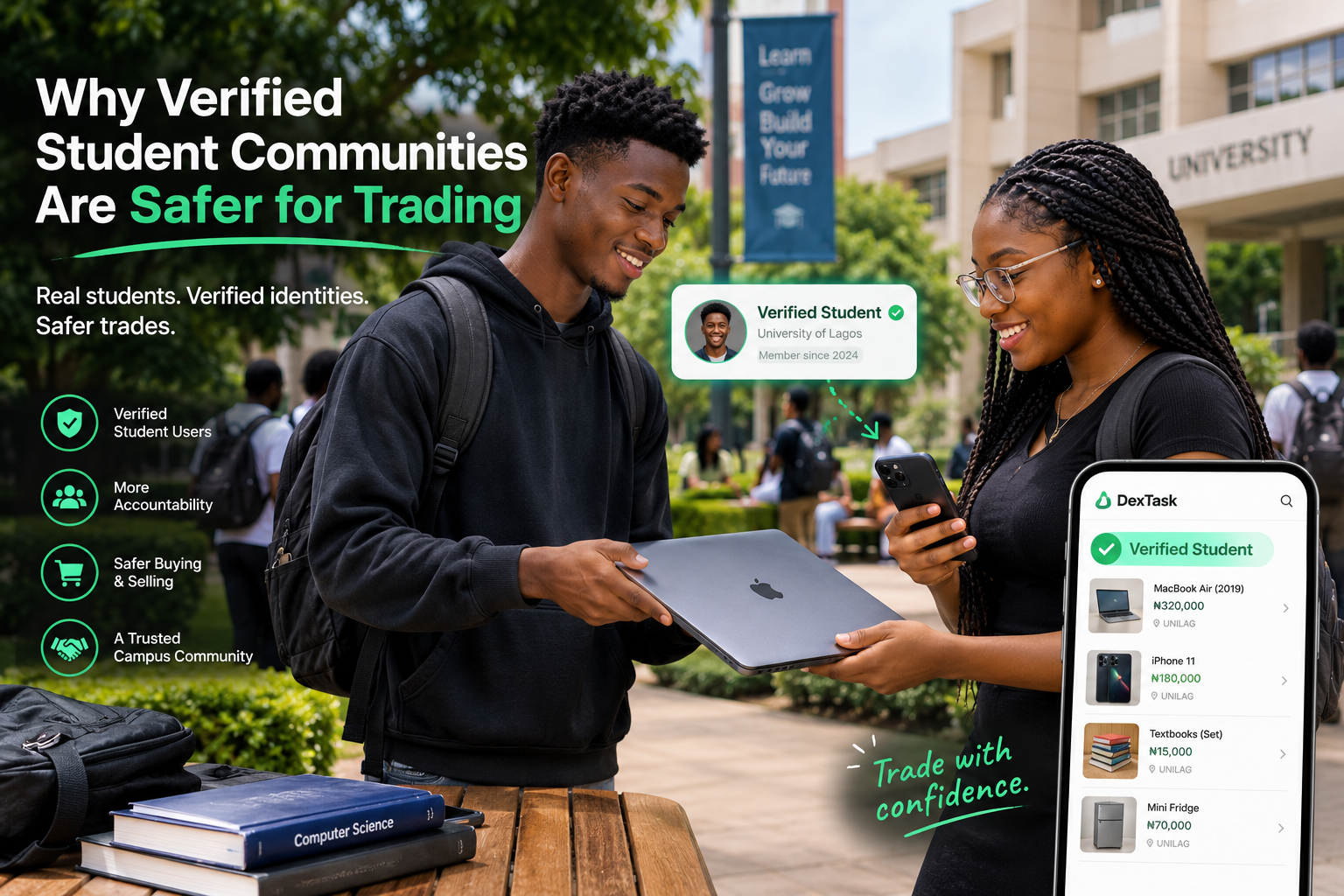
Why Verified Student Communities Are Safer for Trading
Imagine you see a fairly used laptop for sale on WhatsApp Status.
The price looks good. The seller says they're a student. Their profile picture looks normal. They even have other students replying to their Status.
So you send the money.
Then the seller disappears.
The problem wasn't necessarily the laptop. It was the lack of a reliable way to know who was actually behind the account.
This is one reason verified student communities can be useful for campus trading.
When people buying and selling are connected through a community with some form of student verification, there's an additional layer of identity behind the transaction.
It doesn't eliminate risk completely, but it can make trading more structured and give students more information about who they're dealing with.
What Does “Verified Student” Actually Mean?
Verification means a platform or community has taken some steps to confirm that a person meets its requirements for being part of that community.
For a student-focused platform, this could involve confirming a student's connection to their institution through information such as an institutional email address or another verification method.
The exact process depends on the platform.
The important distinction is this:
“This person says they're a student” is different from “This person's student status has been verified by the platform.”
That difference can matter when you're dealing with strangers online.
Why Verification Matters When Buying and Selling
You Know More About Who You're Dealing With
One of the biggest challenges with informal online marketplaces is uncertainty.
A person can create a social media account, upload pictures of an item and claim to be a student at your university.
You may have no easy way to confirm any of it.
A verified student community adds another layer of accountability because membership isn't based solely on what someone claims about themselves.
You're still responsible for making sensible decisions, but you're not starting from zero.
It Creates More Accountability
Think about the difference between meeting a completely anonymous seller online and dealing with someone whose identity has been verified within a student community.
Neither situation guarantees that everything will go perfectly.
However, a verified community can make it harder for someone to hide completely behind an anonymous account.
This can discourage some bad behaviour and make it easier for the platform to enforce its community rules.
It Makes Campus Trading Feel More Familiar
There's a certain comfort in knowing that the person selling a used textbook, phone or mini-fridge is part of the same student community you're using.
You may attend the same institution.
You may even discover that you're in the same faculty, department or campus community.
That doesn't mean you should automatically trust someone.
But knowing you're trading within a verified student environment can provide an additional layer of confidence.
Verified Doesn't Mean “Trust Blindly”
This is very important.
A verification badge is not a guarantee that someone is honest.
A verified student could still:
- Misrepresent an item's condition
- Advertise something inaccurately
- Fail to complete an agreement
- Have a disagreement with a buyer or seller
- Make mistakes during a transaction
So don't see verification as a replacement for common sense.
Think of it as one layer of protection.
You should still inspect items where possible, confirm payments and keep records of your transactions.
Why Informal Trading Can Be Risky
WhatsApp Status, group chats and social media can be useful for finding things to buy.
But they weren't necessarily designed to provide all the structure you need for a marketplace.
A typical transaction might look like:
“I have a phone for sale.”
“How much?”
“₦180k.”
“Send account.”
And that's it.
There may be no proper seller profile, no marketplace history and no organised transaction process.
If something goes wrong, you're left trying to sort it out through DMs and phone calls.
That's where a dedicated student marketplace can be different.
How Verified Communities Can Improve Campus Trading
A well-structured student marketplace can bring several useful elements together.
Verified Users
Knowing that users have gone through a verification process provides more context about who you're dealing with.
Clearer Listings
Instead of scrolling through dozens of WhatsApp Status updates, buyers can browse items in a marketplace designed for buying and selling.
A Student-Focused Environment
The products and services are relevant to the people actually using the community.
One student's unwanted textbook could be another student's semester essential.
One person's old hostel appliance could be exactly what a fresher needs.
More Organised Transactions When buying and selling happens within a platform built for transactions, there can be more structure around the process than simply exchanging bank details in a chat.
This is part of the idea behind DexTask's Campus Marketplace: creating a student-focused space where students can discover items and trade within a community built around verified student users.
What You Should Still Do Before Buying
Even in a verified community, don't skip your own checks.
Before paying for an item:
- Ask questions about its condition.
- Request additional pictures or videos if necessary.
- Inspect the item physically when practical.
- Test electronics before completing a purchase.
- Confirm exactly what is included.
- Compare the price with similar listings.
- Be cautious if the seller is putting unnecessary pressure on you.
- Confirm payment details before transferring money.
If an expensive item is involved, don't let the excitement of a bargain make you careless.
What Sellers Should Do Too
Safety isn't only the buyer's responsibility.
If you're selling something on campus, protect yourself as well.
Confirm Payment Yourself
Don't rely on screenshots as proof that someone has paid.
Check your own account or the relevant payment platform before handing over your item.
Be Honest About the Item
If your phone has a cracked screen, say so.
If the laptop battery doesn't last long, mention it.
If a textbook has missing pages, don't leave that detail out.
Being transparent protects your reputation and reduces unnecessary disputes.
Use Safe Meeting Arrangements
For physical exchanges, choose a sensible public location and let someone you trust know about the meeting when appropriate.
You don't need to invite a stranger directly into your hostel room just because they're buying your old fan.
Verification + Good Trading Habits = Better Protection
The safest approach isn't relying on one feature.
It's combining several good habits.
Verified community + clear listing + sensible communication + safe meeting + confirmed payment = a much better trading experience.
Each layer addresses a different part of the risk.
Verification helps you know more about who you're dealing with.
Clear listings help you understand what you're buying.
Safe payment practices help protect your money.
Good meeting practices help protect you.
That's much better than simply hoping everything works out.
Why This Matters for Nigerian Students
Campus life already comes with enough uncertainty.
You're managing lectures, assignments, transport, accommodation and, sometimes, serious sapa.
So when you're trying to save money by buying second-hand items, you shouldn't have to make the process unnecessarily stressful.
A student-focused marketplace can make it easier to find people within your wider campus community while adding useful layers of structure and verification.
For students using DexTask, Campus Marketplace brings that student-focused approach to buying and selling, while verified users provide an additional layer of confidence when interacting with other members.
Still, verification should always be treated as a starting point—not a reason to ignore basic safety checks.
Final Thoughts
Buying and selling on campus can be one of the easiest ways to save money, clear out things you no longer need or find affordable second-hand items.
But the person behind the listing matters just as much as the item itself.
Verified student communities can reduce some of the uncertainty by giving users a clearer indication that the people they're trading with belong to the intended student community.
It doesn't make every transaction risk-free.
It simply gives you more information, more structure and potentially more accountability than trading with a completely unknown person online.
So before you send money to that “student” selling an unbelievably cheap phone on WhatsApp, take a moment to ask yourself:
Do I actually know who I'm dealing with?
If the answer is no, a verified student marketplace may be the smarter place to start.
Looking for a safer, more organised way to buy and sell with fellow students? Explore DexTask's Campus Marketplace and trade within a verified student community.
Written by
Blessing Ajayi · DexTask
Publisher: DexTask
Published on the DexTask blog covering campus mobility, student infrastructure, and product updates across Nigeria and Africa.
Related posts
Buying Fairly Used Gadgets on Campus: A Checklist
A fairly used gadget can save you money, but a bad deal can leave you with an expensive problem. Use this simple checklist before buying a phone, laptop or other gadget on campus.
Buying & Selling Safely on Campus: Avoiding “WhatsApp Status” Scams
Buying and selling on campus can save you money—or cost you if you’re not careful. Learn how to spot WhatsApp Status scams, verify buyers and sellers, and make safer campus transactions.
Resolving Payment Disputes for Campus Work
A campus gig doesn't always go exactly as planned. Learn what to do when a client or freelancer disagrees about payment, deliverables or completed work.