
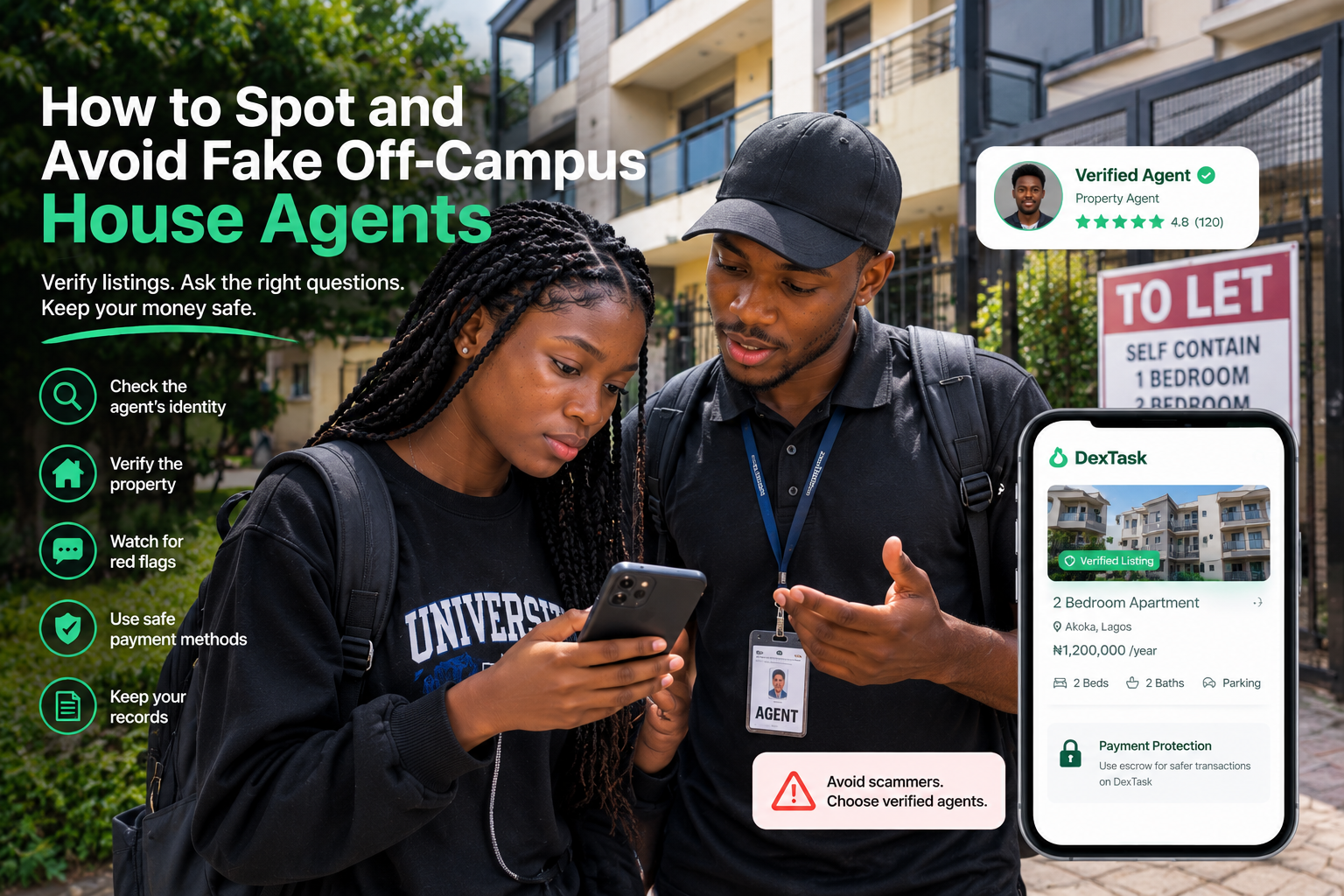
How to Spot and Avoid Fake Off-Campus House Agents
Finding accommodation off campus can be stressful enough without discovering that the person showing you the house isn't actually authorised to offer it.
You may see a beautiful room advertised online, chat with an “agent” on WhatsApp, pay a fee to secure the property—and later discover that the house isn't available, the person isn't connected to it, or the listing wasn't genuine in the first place.
For students, losing accommodation money can be a serious setback.
So before you start sending money because someone says, “Pay now before another student takes it,” slow down.
Here are practical ways to spot suspicious house agents and protect yourself while searching for off-campus accommodation.
Why Students Are Easy Targets for Accommodation Scams
Students looking for houses often have similar pressures.
You may:
- Be new to the area
- Need accommodation quickly
- Have limited knowledge of neighbourhoods around campus
- Be searching during a busy accommodation period
- Be relying on WhatsApp groups or social media
- Have parents or guardians sending money for the house
Scammers can take advantage of that urgency.
A listing that looks like the perfect room at the perfect price can make you ignore questions you would normally ask.
That's why verification should come before payment.
Red Flags That an Agent May Be Fake 1. They Want Money Before You See the Property
One of the biggest warning signs is being asked to send a large payment simply to “secure” a house you haven't properly inspected.
You should know exactly what you're paying for before handing over money.
If someone refuses to let you view the property and keeps pushing for payment, take a step back.
2. The Price Looks Suspiciously Good
You find a spacious apartment close to campus at a price far below what similar properties are being advertised for.
Maybe you've found an amazing deal.
Maybe there's a catch.
Compare the property with similar accommodation in the same area. A surprisingly cheap listing deserves more questions, not less.
3. They're Creating Too Much Urgency
Watch out for statements like:
“Send the money now or I'll give it to someone else.”
“There are five students waiting.”
“You have only 30 minutes to pay.”
Some genuine properties may have other interested students, but pressure should not replace verification.
If someone is deliberately rushing you before you've checked the property and the transaction, that's a reason to pause.
4. They Avoid Specific Questions
Ask simple questions about the property:
- Where exactly is it?
- Who manages the property?
- What is included in the payment?
- When can I inspect it?
- What other charges apply?
- Who will I be dealing with after payment?
A legitimate person should be able to provide useful information or explain when they need to confirm something.
Constantly changing the subject or giving vague answers is worth noticing.
Don't Trust a House Video Alone
A video walkthrough can be useful, but it isn't proof that the person sending it has the right to offer you the property.
The video could be old.
It could belong to another property.
It could even have been taken from someone else's listing.
If you're seriously considering the accommodation, see the property yourself or have someone you trust inspect it on your behalf.
Check that the actual building matches the pictures and description.
Verify the Person Behind the Listing
Before dealing with an agent, find out who you're actually talking to.
Ask for their:
- Full name
- Contact details
- Agency or business name, if applicable
- Connection to the property
- Relevant identification or documentation, where appropriate
Then independently verify the information you can.
For example, don't rely entirely on a phone number or social media account that the person provided. Look for other evidence that connects the person to the property or agency.
A professional-looking WhatsApp profile is not proof of legitimacy.
Speak to People Around the Property
If you're physically viewing a house, pay attention to the environment.
You can ask reasonable questions of people who live nearby or current occupants, such as whether the property is actually available and who manages it.
You don't need to interrogate the entire street.
Sometimes a simple conversation can reveal that the “available apartment” has actually been occupied for months.
Ask for a Proper Breakdown of Costs
Don't assume the advertised rent is the total amount you'll need to pay.
Ask the agent or property manager to explain every charge being requested.
For example:
- Rent
- Agency-related charges, if applicable
- Agreement or documentation charges, if applicable
- Service or maintenance-related charges
- Other stated fees
The exact charges can vary depending on the property and arrangement, so get a clear breakdown before paying anything.
If someone suddenly introduces several unexplained charges after you've already committed money, stop and clarify them.
Never Let Your Excitement Make the Decision
This is especially important when the house looks perfect.
You finally find:
- A decent room
- Good water supply
- Close proximity to campus
- Electricity that seems manageable
- A nice environment
- A price you can afford
You're excited.
Then the agent says:
“Just transfer ₦200,000 now so I can remove the listing.”
Pause.
The fact that you love the house doesn't mean you've finished your verification.
Take a breath and complete the necessary checks first.
Be Careful With Payment
Payment is where a suspicious transaction can become an expensive problem.
Before transferring money:
- Confirm what the payment is for.
- Confirm who you're paying.
- Make sure the property has been properly verified.
- Keep the relevant messages and documents.
- Get evidence of the agreed terms.
- Don't send money simply because you're afraid of losing the property.
If the payment is being made to an individual, ask why that person is receiving it and what their relationship to the property is.
For significant payments, involve a trusted parent, guardian or experienced person where appropriate.
A second pair of eyes can be useful when you're dealing with a large amount of money.
Be Careful With Fake Documents
Someone can send you a document and call it a tenancy agreement, receipt or proof of ownership.
The existence of a document doesn't automatically prove that everything about the transaction is genuine.
Look at the details carefully and ask questions when something doesn't make sense.
If the transaction involves significant money or complicated documentation, consider getting appropriate professional advice before committing.
Keep Your Own Records
Don't depend on memory.
Save:
- The original property listing
- Photos and videos
- WhatsApp conversations
- Names and contact details
- Payment records
- Receipts
- Relevant documents
- Any agreement about the property
If the listing suddenly disappears after you've paid, having your own records is much better than trying to reconstruct the entire transaction later.
Don't Go Alone If You Can Avoid It
If you're meeting someone you don't know to inspect accommodation, consider taking someone you trust.
Apart from personal safety, another person can help you notice things you might overlook.
They may ask:
“Why is the landlord's name different from the person we're paying?”
Or:
“Didn't the agent just say electricity was included?”
Sometimes you simply need another person to hear the conversation.
What If You Already Paid and Something Feels Wrong?
Don't send even more money simply because the person says another payment will “unlock” your accommodation.
Stop and review what has happened.
Gather your:
- Payment evidence
- Conversations
- Property details
- Agent information
- Documents
- Original listing
Then contact the relevant payment provider or financial institution promptly if you believe a fraudulent transaction has occurred, and seek appropriate local assistance where necessary.
If you have a parent, guardian or trusted person who understands property transactions, involve them rather than trying to handle everything alone.
A Quick House-Agent Checklist
Before paying an off-campus agent, ask yourself:
-
Have I physically inspected the property?
-
Does the actual property match the listing?
-
Have I confirmed who the agent is?
-
Can they explain their connection to the property?
-
Do I understand all the requested charges?
-
Have I asked when and how the accommodation will be handed over?
-
Have I kept copies of the important information?
-
Have I verified the payment details?
-
Have I had someone I trust review the deal if the amount is significant?
-
Am I being rushed into paying?
If several answers are “no,” don't rush the payment.
Final Thoughts
Finding an off-campus house is already a lot to deal with as a student. You shouldn't have to add recovering money from a fake agent to the list.
The safest approach is simple:
See the property. Verify the person. Understand the costs. Keep your records. Then pay.
Don't allow a beautiful room, a cheap price or a “pay now” message to make you skip the checks that matter.
And remember, a legitimate-looking listing can still require verification. Your job isn't to prove that every agent is a scammer—it's to make sure you have enough information to make a confident decision before your money leaves your account.
Looking for useful student services and campus opportunities? Explore DexTask to discover a student-focused platform built around helping students connect and get things done.
Written by
Blessing Ajayi · DexTask
Publisher: DexTask
Published on the DexTask blog covering campus mobility, student infrastructure, and product updates across Nigeria and Africa.
Related posts
10 Best Side Hustles for Nigerian Students in 2026
Looking for a side hustle as a Nigerian student? Here are 10 realistic ways to earn around your lectures, plus how DexTask can help you turn your skills into campus opportunities.
How to Move Around FUTA: Shuttle & Keke Fares Explained
Learn how to use DexTask Rides & Routes to find your way around FUTA, book a campus keke, check your fare, track your ride, and rate your operator.
Resolving Payment Disputes for Campus Work
A campus gig doesn't always go exactly as planned. Learn what to do when a client or freelancer disagrees about payment, deliverables or completed work.